
A Life Worth Waking For
On ikigai, presence, and what the Venn diagram failed to mention
I stumbled upon the concept of ikigai the way most people do: as a diagram. Four circles, a tidy center, the suggestion that purpose was findable if you just asked yourself the right questions.
I saved it somewhere, the way you save things that feel almost true. And then I kept noticing, in the work I do, in the people I sit with, in my own life, that meaning never seemed to arrive the way the diagram suggested. It was already there, or it wasn't. It didn't wait to be optimized into existence.
生き甲斐
i · ki · ga · i
“that which makes life worth living"
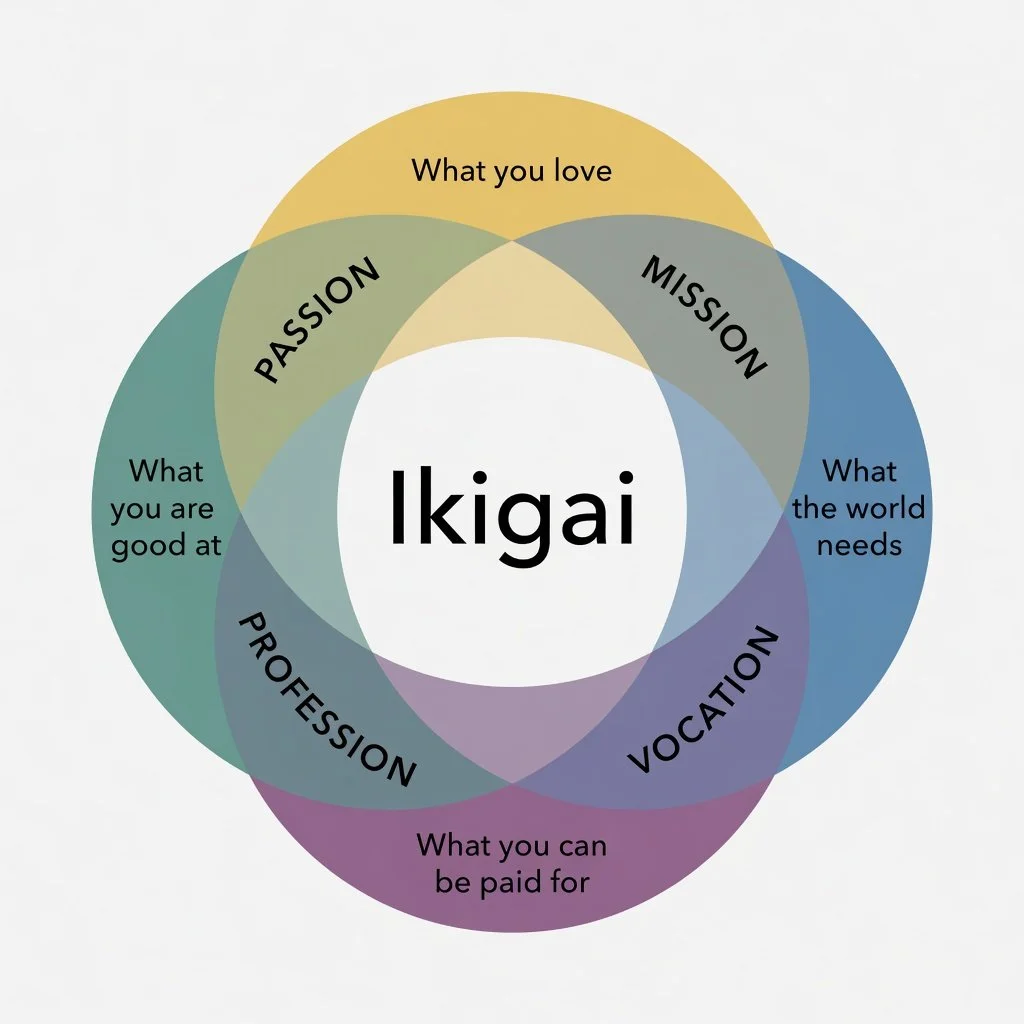
The familiar version arrives as a four-circle Venn diagram: what you love, what you’re good at, what the world needs, what you can be paid for. Find the center of those four circles, the framework promises, and you will find your life’s purpose. It spread through wellness culture in particular with unusual confidence, as if it had always been there, embedded in Japanese wisdom, waiting to be uncovered.
It was not. The diagram was largely constructed by a Spanish author drawing on Western frameworks of vocational fulfillment and career dissatisfaction. The Japanese understanding of ikigai is something far quieter.
Not a destination
Psychologist Michiko Kumano defines ikigai as a state in which a person experiences meaning and purpose alongside the feeling that life is worth living. Read that again slowly. There is no mention of career, income, or calling. The emphasis is on feeling, on a quality of lived experience available in any given moment, not a summit reached after sufficient self-optimization.
In Okinawa, where researchers have spent decades studying why people live so long and with such apparent lightness, the elders asked about their ikigai rarely point to work. They point to a garden tended at the same hour each morning. To a grandchild's particular laugh. To the preparation of a meal for someone who will eat it slowly and with gratitude. These are not grand answers. They are simple, pure, and specific to each.
What strikes me, working in a healing practice, is how much this resembles what I observe in clients who have genuinely found their footing. Not those who have sorted out their career trajectory or identified their strengths, but those who have learned to fully inhabit their days. They are often unremarkably occupied. They are almost always calm in a way that has nothing to do with the absence of difficulty.
Where presence lives

There is a woman who has arranged flowers for thirty years. Not for a shop or a ceremony, but because she cannot pass a flower stand without seeing what the stems are asking to become. She does not describe this as her purpose. She would probably find that language strange. She simply does it, with the same quality of attention each time, with her hands knowing things her words do not.
This is what the Japanese call kodawari, a devotion to doing small things with full attention. It is related to ikigai without being identical to it. Kodawari is the practice; ikigai is what the practice opens us to.
This is where the Western Venn diagram quietly misleads. By framing ikigai as something to be found at the intersection of four external factors, it positions meaning as a future state contingent on the correct arrangement of your life. It makes meaning a destination. The Japanese conception makes it a quality of attention available right now, in whatever you are doing, provided you are genuinely doing it.
What ikigai asks of you
Nothing.

That is not an evasion. Every Western framework for meaning makes a demand: discover yourself, align your values, optimize your strengths, find your calling. Ikigai simply asks you to notice what is already making you lean toward. The walk you take at the same hour each evening, not to arrive anywhere, but because the light does something particular to the trees. The letter you write by hand because the words deserve the weight of ink.
A sculptor finishes a piece, stands back, and immediately wants to begin the next one, not from dissatisfaction but from a hunger she can’t describe. She has never once needed to ask what her life is for. The question does not arise, because the answer is already present in the wanting.
In Reiki practice, we often talk about the difference between doing and being. Doing is effortful, goal-directed, measurable. Being is what happens when the effort relaxes and something more spacious takes its place. Ikigai, properly understood, lives entirely on the being side of that distinction. It is not achieved. It is inhabited.
A different kind of purpose
I am not suggesting that career alignment is unimportant, or that finding meaningful work is not worth pursuing. It is. But when we dress a productivity framework in philosophical clothing, we risk something specific: we export anxieties about purpose into a tradition that was, quietly, offering us an antidote to those very anxieties.
The gift of ikigai is not a better strategy for your professional life. It is permission to find your life meaningful. To let the small rituals of care, the steady showing up, the hands that remember what to do, be enough. To stop treating aliveness as something you will feel once you have arranged and rearranged your life correctly.
You may already have it. It may be in the quality of attention you bring to the table, to the room, to the canvas, to the person in front of you. That attentiveness is not a means to something larger. It is, itself, a life worth waking for.
生
The word for life and the word for living are the same in Japanese. The practice was always the point.