
The Long Echo: How the Past Lives On in the Body, and How We Finally Let It Rest
Your immune system is flaring. Your muscles ache for no reason. You're exhausted in a way that sleep never fixes. The doctors have run all the tests. Perhaps they found something, perhaps they didn't. But somewhere, deep in your nervous system, an old story is still being told.
The Science of Stored Trauma: When the past lives in the body
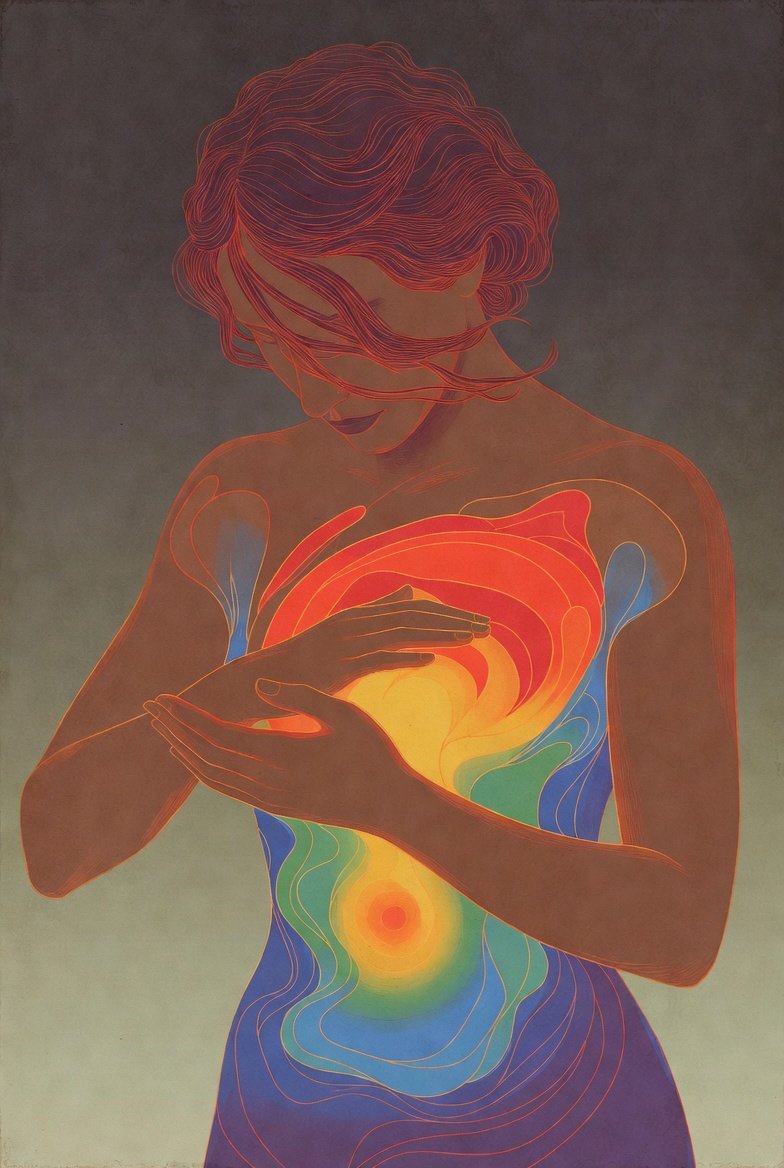
We tend to think of trauma as something that lives in the mind - a memory, a bad dream, a flinch at a familiar sound. But decades of research in neuroscience, neuro-immunology, and somatic work are closing in on a radical and deeply important truth: emotional trauma is also a physiological event. It lives in the tissues, the fascia, the gut, and the immune cells.
When we experience something overwhelming, be it abuse, loss, shame, fear, chronic stress, or emotional neglect, our nervous system activates a survival response. Adrenaline floods the body. The heart races. Muscles contract. Blood diverts to the limbs. This is the ancient, brilliant mechanism of fight, flight, or freeze.
In a healthy cycle, once the threat passes, the nervous system returns to equilibrium. We shake it off, literally, as animals do. But when the threat is prolonged, when there is no safe exit, or when the overwhelm is too great, the nervous system can become stuck in a state of chronic activation. The alarm keeps ringing even when the fire is out.
As Dr. Bessel van der Kolk wrote, the body quite literally keeps the score. The survival state, the cortisol, the inflammation, the muscle bracing, becomes a default setting rather than an emergency response.
The body is not a passive container for the mind's suffering. It is an active participant, and it has its own memory, its own language, and its own path to healing.
How Stored Trauma Becomes Physical Illness: The invisible bridge between emotion and disease
When the nervous system stays locked in a stress response, the downstream effects on the body are enormous. Cortisol, meant to be a short-term survival chemical, becomes chronically elevated. Over time, this rewires the body's regulatory systems, including the very immune system designed to protect us.
Autoimmune Conditions: Chronic stress dysregulates the immune system, contributing to conditions like lupus, rheumatoid arthritis, Hashimoto's, and Crohn's disease.
Chronic Pain & Tension: Unresolved trauma is held in the muscles and fascia as chronic bracing, leading to fibromyalgia, back pain, pelvic floor issues, jaw tension, and headaches.
Nervous System Dysregulation: The autonomic nervous system loses its natural flexibility between activation and rest, resulting in anxiety, insomnia, or exhaustion.
Gut & Digestive Issues: The gut-brain axis is profoundly affected by chronic stress, contributing to IBS, inflammation, poor absorption, and immune dysfunction.
Neurological Symptoms: Brain fog, sensory sensitivity, dissociation, and memory challenges all reflect how deep nervous system dysregulation can reach.
This isn't weakness. It isn't "all in your head." It is the predictable, measurable result of a nervous system that learned to survive in a world that felt dangerous, and hasn't yet received the message that it is safe now.
The Brain That Changed Itself
Here is where the hope lies. For much of the twentieth century, neuroscience believed that the adult brain was essentially fixed, that neurons formed in childhood were the architecture we were stuck with. We now know this is profoundly wrong.
The brain is neuroplastic. It reorganizes itself in response to experience throughout our entire lives. Neural pathways that are repeatedly activated grow stronger, and those that go unused fade. This is the same mechanism that once locked a trauma response into place, and it is also the mechanism we can deliberately work with to create new patterns.
Neural retraining is the practice of intentionally forming new neural pathways to replace those that have kept the nervous system trapped in survival mode. It works not by suppressing or erasing the past, but by building new roads, new habitual patterns of response, that gradually become the default routes the nervous system travels.
Programs like Primal Trust, DNRS (Dynamic Neural Retraining System) and Gupta Program, as well as practices rooted in somatic therapies, EMDR, Internal Family Systems, and polyvagal-informed healing, are all working within this same fundamental truth: the nervous system can learn to feel safe again. And when it does, the body often begins to heal in ways medicine alone could not achieve.
We cannot think our way out of a survival state. Healing happens not just in the mind, but through the body, the breath, the hands, and the felt sense of safety, experienced again and again until it becomes the new normal.
Pathways to Healing: A toolkit for the nervous system
Reiki

Reiki works through gentle, intentional touch to support the body's own self-healing capacity. From a Western perspective, it activates the parasympathetic nervous system, shifting the body out of the fight-or-flight response and into the rest-and-digest state where cellular repair becomes possible. Clients consistently report deep relaxation, reduced pain, emotional release, and an improved sense of wellbeing. For trauma survivors, the non-invasive, permission-based nature of Reiki makes it particularly accessible as healing can happen without revisiting the story. Many people notice, over a series of sessions, a gradual "unlocking" of areas where tension, grief, or fear had been held for years.
From a non-Western perspective, rooted in Japanese traditions, Reiki works with ki (also known as chi or prana): the vital life-force energy that flows through all living things. Trauma, grief, and chronic stress are understood to create stagnation or imbalances in this flow, disrupting the body's energetic pathways, or meridians, and causing imbalance in the chakras, the energy centers that correspond to different aspects of physical and emotional wellbeing. A Reiki practitioner acts as a clear channel for this universal energy, helping to restore flow, and bring the energetic body back into harmony. In this tradition, illness is often seen not as a mechanical failure but as a message, an energetic imbalance asking to be witnessed and released. When the energy moves freely again, the physical and emotional layers tend to follow. Many who have carried chronic illness, grief, or unexplained pain for years describe Reiki sessions as the first time their body felt truly held, not just treated.
Somatic Experiencing
Developed by Dr. Peter Levine, Somatic Experiencing helps trauma complete its biological cycle in the body. By gently tracking physical sensations, rather than re-living traumatic narratives, the nervous system is given permission to discharge the stored survival energy that was never fully released. This can look like trembling, warmth, yawning, or spontaneous movement as the body finally lets go of what it has been holding.
Breathwork
The breath is the only autonomic function we can also control consciously making it a uniquely powerful tool for nervous system regulation. Slow, diaphragmatic breathing directly activates the vagus nerve, stimulating the parasympathetic response. Practices like coherence breathing (6 seconds in, 6 seconds out), 4-7-8 breathing, or extended exhale techniques like the physiological sigh have been shown to reduce cortisol, lower heart rate, reduce anxiety, and over time, actually shift autonomic baseline tone. For those with stored trauma, breathwork can also facilitate emotional release and expanded somatic awareness.
Neural Retraining Programs
Structured programs like Primal Trust, DNRS, the Gupta Program, and TMS recovery approaches combine visualization, positive emotional activation, neuroplasticity education, and incremental limbic retraining to gradually shift the brain out of a chronic threat-response pattern. Consistency matters more than intensity as small daily practices accumulate into profound rewiring over months.

Meditation & Yoga Nidra
Regular meditation practice measurably changes the brain, shrinking the amygdala (the threat-detection center), thickening the prefrontal cortex (the center of regulation and perspective), and shifting the baseline toward greater calm. Yoga Nidra, a form of guided non-sleep deep rest, brings the nervous system into a state of theta brainwave activity where deep physiological restoration occurs and the subconscious is more receptive to new patterns. Even 20 minutes daily, practiced consistently, can produce significant shifts in nervous system tone over weeks to months.
Nature & Co-Regulation
The nervous system does not heal in isolation, it heals in relationship. Our nervous systems are literally designed to regulate each other. In the presence of a calm, safe person, our own system begins to settle. This is why friendship, loving touch, and time with animals are not luxuries for healing, they are medicine. Similarly, time in nature measurably reduces cortisol and activates the parasympathetic system. The ancient, unhurried presence of trees, water, and soil signals to the deepest parts of the nervous system that the world is not only danger. There is rest here, too.
You are not broken. You are adaptive.
Everything your body did, the bracing, the inflammation, the hypervigilance, the shutting down, was a brilliant act of survival. Your nervous system did exactly what it was designed to do. It kept you alive. It absorbed what you could not process at the time and held it until you were ready.
The work of healing is not the work of fixing something broken. It is the work of gently, patiently updating the story your nervous system is telling - from one of ongoing danger to one of earned safety. It takes time. It takes repetition. It takes compassion toward yourself.
But the brain is plastic. The body is intelligent. And the nervous system, with the right conditions, can learn to release what it no longer needs to hold. You do not have to carry this forever, I promise.