
The 5,000-Year-Old Secret Behind the Technique I Recommend to Everyone
What EFT Is, How It Works, and Why I Recommend It to Almost Everyone
If you've spent any time in my world, whether you've come to me for Reiki, heard me mention it in conversation, or know me personally, you may have heard me talk about EFT tapping. It's one of those tools I return to again and again, personally and professionally, because the results speak for themselves.
So today I want to give it the full introduction it deserves.
What Is EFT Tapping?

EFT stands for Emotional Freedom Technique aka Meridian Tapping. At its core, it's a mind-body practice that involves gently tapping with your fingertips on specific points along your body's energy meridians while focusing on a thought, feeling, memory, or physical sensation that you want to shift.
Think of it as a bridge between ancient Eastern energy medicine and modern Western psychology. It draws from the same energetic map used in acupuncture and acupressure, but instead of needles, you use your own fingertips. And instead of simply treating the body, EFT works simultaneously with the nervous system and the mind.
A Little History: Where Did EFT Come From?
The roots of EFT stretch back thousands of years to Traditional Chinese Medicine (TCM), which mapped a network of invisible energy channels throughout the body called meridians. These pathways carry qi (life force energy), and blockages or imbalances in the flow of qi are understood to be at the root of physical and emotional illness. Acupuncture and acupressure developed as ways to stimulate specific points along these meridians to restore balance and promote healing.
Fast forward to the 20th century. In the 60s and 70s, a chiropractor named Dr. George Goodheart began exploring the connection between muscle testing, meridian points, and emotional wellbeing, laying the groundwork for what would become Applied Kinesiology, another one of my favorite modalities.
His work influenced psychiatrist Dr. John Diamond, who in the 1970s began using affirmations alongside meridian points, coining the term "Behavioral Kinesiology."
Then came Dr. Roger Callahan, a psychologist who in 1980 made a breakthrough that would change everything. While working with a patient with a severe water phobia, he intuitively tried tapping on the acupressure point beneath her eye - a stomach meridian point - while she focused on her fear. Her phobia reportedly vanished in minutes and did not return. Callahan went on to develop Thought Field Therapy (TFT), a structured tapping system based on this discovery.
His student, Gary Craig, later simplified and refined TFT in the 90s, creating the standardized protocol we now know as EFT. Craig made it accessible to everyone, not just practitioners, and began sharing it freely. From there, EFT spread around the world and has since been the subject of hundreds of clinical studies and trials.
How Does EFT Actually Work?
This is where it gets genuinely fascinating, especially for those of us already working with energy.
When we experience stress, trauma, fear, grief, or emotional pain, the body doesn't just feel it, it stores it as information. The amygdala, the brain's alarm system, encodes threatening experiences as survival memories. These stored patterns can keep us locked in cycles of anxiety, reactivity, physical tension (TMS anyone?), and emotional pain, even long after the original event has passed.
Tapping works on two levels at once:
1. The Neurological Level
Research shows that tapping on meridian points sends a calming signal directly to the amygdala, reducing cortisol and down-regulating the sympathetic (fight-or-flight) response. A pivotal study by Dr. Dawson Church found that a single EFT session reduced cortisol levels by an average of 24% - significantly more than the other therapeutic interventions tested.
When you tap while focusing on a distressing thought or feeling, you're essentially teaching your nervous system that this thing is no longer a threat. You're interrupting the stress response in real time and creating new neural pathways.
2. The Energetic Level
From an energy medicine perspective, one I find deeply resonant in my Reiki practice, tapping stimulates the meridian points to clear stagnant energy. Negative emotions, unresolved trauma, and chronic stress can create energetic congestion along these pathways. The combination of focused awareness (naming what you're feeling) and meridian stimulation (tapping the points) creates a powerful signal: the emotional charge attached to a memory or belief begins to dissolve.
How it’s done
A standard EFT session typically follows this sequence:
Identify the issue - a specific emotion, memory, belief, or physical sensation
Rate the intensity on a scale of 0–10
Setup statement - while tapping the karate chop point, repeat a phrase that acknowledges the problem and offers self-acceptance (ex. "Even though I feel this anxiety in my chest, I deeply and completely love and accept myself")
Tap through the sequence - gently tapping 5–7 times on each of 9 points while voicing the feeling in whatever way comes naturally to you, on repeat. (ex. “My chest feels so tight. I feel like I can’t breathe. My hands are so shaky.” )
Re-rate the intensity and repeat as needed until relief is felt
The Points:
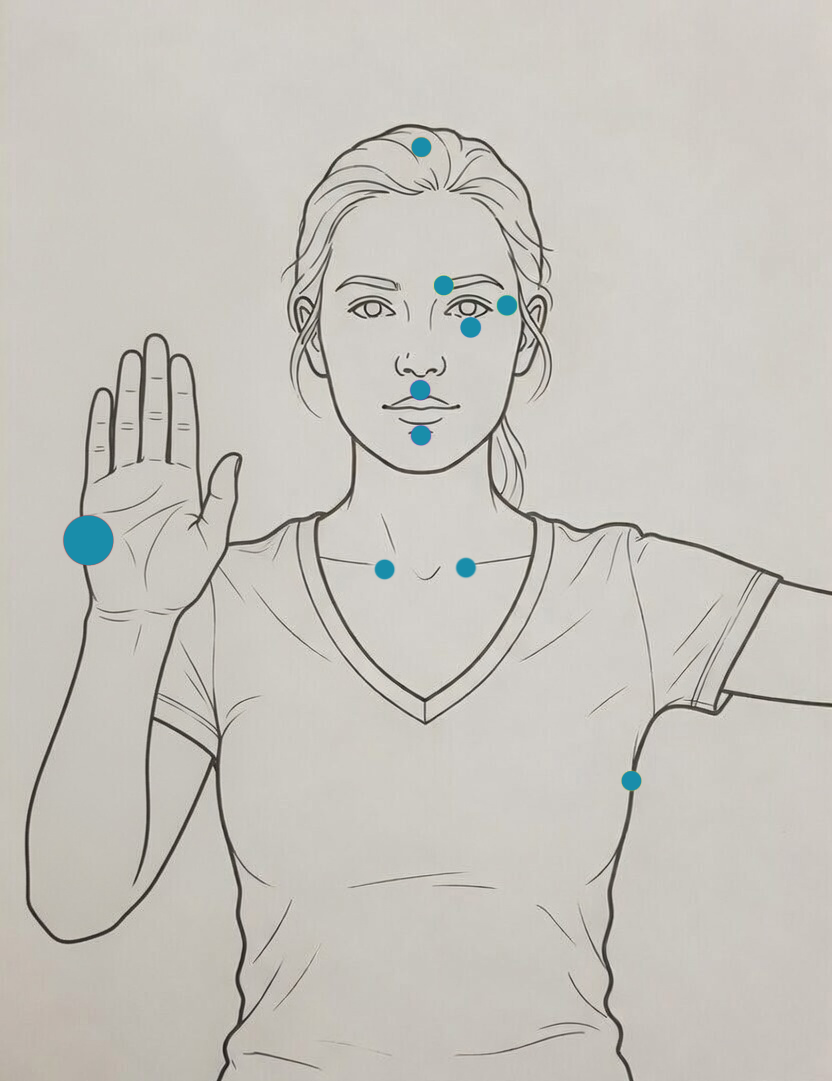
EFT Tapping Points
karate chop point (side of hand)
top of head
inner eyebrow
outer eye
under nose
chin
collar bone
under arm
back to karate chop point
and so on…
It sounds simple. And it is, which is part of its beauty. But simple doesn't mean shallow. The shifts people experience can be profound.
Who Can EFT Help?
Honestly? In my experience, almost anyone. I use it myself regularly - for stress and overwhelm, for processing difficult emotions, for clearing mental clutter before important conversations, for physical tension that just won't release. It has become as natural a part of my wellness routine as Reiki, meditation, or a long walks outside.
I suggest it to clients, to friends, to family members who are open to it. Here's a partial list of what EFT has been studied for and is widely used to address:
Anxiety and stress - including generalized anxiety, social anxiety, and performance anxiety
Trauma and PTSD - EFT has been used extensively with veterans and survivors of abuse
Phobias and fears - often resolved in just a few focused sessions
Depression and grief - by clearing the emotional weight stored in the body
Chronic pain - because emotional trauma and physical pain are deeply interconnected
Limiting beliefs - the inner narratives that hold us back ("I'm not good enough," "I don't deserve this," etc.)
Cravings and addictions - by addressing the emotional triggers underneath
Sleep issues - by calming the nervous system before rest
Relationship patterns - clearing old wounds that replay in present relationships
Performance and confidence - athletes, speakers, and creatives use it to get out of their own way
As with Reiki, EFT is not a replacement for medical care. But as a complement to conventional treatment, and as a powerful self-care practice, it is remarkably versatile.
EFT and Reiki: A Natural Partnership
What I love about EFT in the context of Reiki is how naturally these two modalities align. Both work with the body's energy system. Both honor the connection between emotional wellbeing and physical health. Both operate on the understanding that the body has an innate intelligence and capacity for healing.
Where Reiki offers a receptive, deeply restful experience of energetic restoration, EFT adds an active, participatory dimension, giving you a tool you can reach for anytime, anywhere, on your own. Together, they support healing at multiple levels: the deep energetic repatterning of Reiki, and the targeted, conscious release of EFT.
Many of my clients find that adding tapping to their practice accelerates their progress and gives them a greater sense of agency over their own healing. There is something genuinely empowering about having a technique in your hands, quite literally, that you can turn to in a moment of overwhelm.
Want to Learn More?
If you're curious about EFT - whether you'd like some guidance getting started or want to incorporate tapping into our work together - I'd love to hear from you. Whatever the modality, my intention is always the same: to support your healing in ways that are practical, accessible, and deeply effective.